Confronting Piano Struggles: Small Hands and the Risk of Pain

Updated: Jun 3, 2024
Mastering a piece on the piano can be a delightful journey, but for pianists with smaller hands, it often comes with unique and personal challenges. According to the survey, 15 out of 20 respondents reported facing difficulties due to the texture of the piano pieces, impacting their performance.
In their book "Adaptive Strategies for Small-Handed Pianists", L. Deahl & B. Wristen identified several particularly challenging elements in piano music. These include
thick chords
octaves and brocken octaves
tenths
extended arpeggios
widespread melodies
managing two or more voices in one hand
Among these, tenths and thick chords emerged as the most problematic for many pianists. Understandably, these complex structures can lead to discomfort or even pain while playing, arpeggios and widespread melodies can be adapted more easily because they often involve fewer notes being played together.
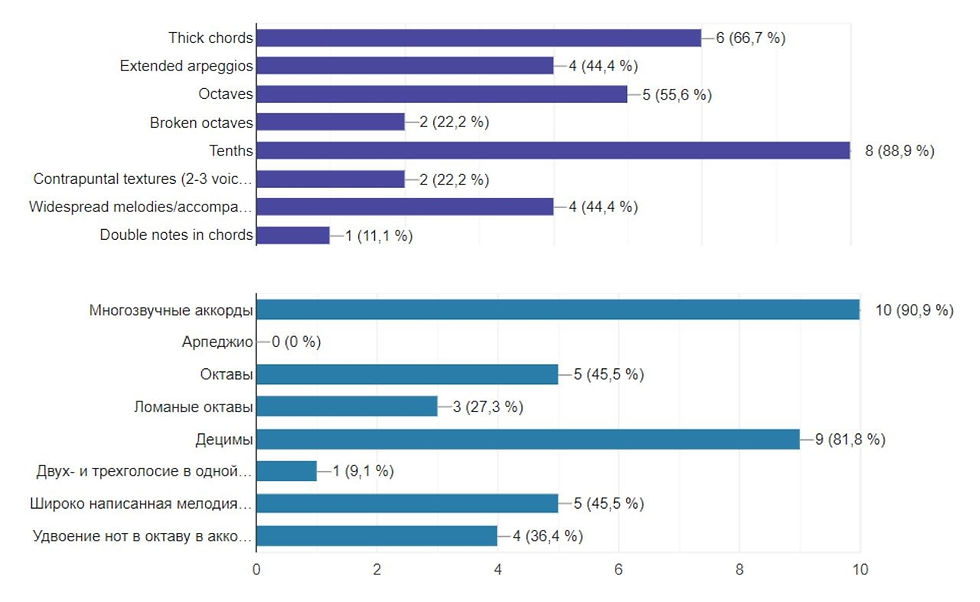
Sadly, the survey also revealed that discomfort or pain while playing is a common experience, with only 4 respondents reporting almost never encountering such issues.
5 pianists reported sustaining injuries as a result of struggling with uncomfortable parts in a piece.
Some pianists shared their exercises to work on hand stretch:
Keeping the thumb on one key and try to hit as far as I can, with relaxing in between.
I used exercises from Rennie and Geehl and specific Chopin etudes op 10/1 and his favourite extended dim 7th patterns etc. and I have used 'yoga hands' (spreads the fingers with foam inserts) - after seeing Rubinstein's demonstration I started widening the thumb to pinky span towards 180 deg.
While stretching exercises can indeed help expand the reach and flexibility of the hands, pushing too hard or too quickly can strain the muscles and tendons, leading to pain and potential long-term damage as well. It's essential for pianists, especially those with smaller hands, to strike a balance between effective stretching and injury prevention.
Additionally, proper warm-up and cool-down routines are essential to prepare the hands and fingers for playing and to aid in recovery afterward. Gentle stretches, massage, and relaxation techniques can help reduce tension and promote flexibility without risking injury.
In conlusion I want to say that understanding the unique needs of small-handed pianists and implementing adaptive strategies such as thoughtful fingerings, hand positions, and modifications to the music, it becomes possible to navigate these obstacles with grace and precision.
Moreover, fostering a supportive community where pianists can share experiences, exchange tips, and encourage one another is crucial in overcoming these challenges together. Every pianist, regardless of hand size, deserves the chance to pursue their passion for music without limitations.
You are welcome to share about yourself and your opinion in my survey! Follow the link below!
In English
In Russian


Comments